
cuda-mpqs — Factoring RSA-class integers entirely on GPU
Christoph Heinrichs and Fabian Januszewski developed an open-source CUDA implementation of the Self-Initializing Quadratic Sieve that factors semiprimes (up to 512 bits) on GPU hardware. Which started as a proof-of-concept project we implemented an integer factorization pipeline which runs entirely on GPU, including sieving, large prime processing, linear algebra stage (Block-Wiedemann), and square-root step, achieving SOTA performance for integers in the 100 digit range, e.g. RSA-100. We validated our implementation factoring RSA-110 & RSA-120 on consumer grade hardware and RSA-130, RSA-140 and RSA-150 on clusters of A100 and H100 GPUs respectively. On July 14th 2026 we factored the 512 bit challenge number RSA-155 which appears to be the largest factorization ever completed with the Quadratic Sieve.
Implementation details:
- six-stage pipeline, ~63,000 lines of code, ~140 CUDA kernels
- GPU Architectures: Tested on NVIDIA GPUs from Turing (2018) to Blackwell (2025)
- Current version: 1.0.6, first public release 03.06.2026 (v1.0.0)
We maintain two github repositories, one for cuda-mpqs including block-wiedemann and one for block-wiedemann only.
- License: LGPL-3.0-only + NVIDIA CUDA Toolkit exception
- Source code cuda-mpqs (CH+FJ): https://github.com/drjanosch42/cuda-mpqs
- Block-Wiedemann Linear-algebra solver (FJ): https://github.com/drjanosch42/block-wiedemann
Performance
For RSA-100 we achieve SOTA performance. On a consumer RTX 5070 Ti GPU cuda-mpqs factors RSA-100 in < 2 minutes, on a data-center class H100 SXM GPU in < 1 minute.
| GPU / Platform | Architecture | CUDA core count | RSA-100 (v1.0.4) | RSA-100 (v1.0.6) |
|---|---|---|---|---|
| Jetson Orin Nano 8 GB (25W) | Ampere (SM 8.7) | 1,024 | 39 m 56 s | 40 m 05 s |
| TITAN RTX 24 GB | Turing (SM 7.5) | 4,608 | 3 m 39 s | 3 m 19 s |
| A100 SXM4 | Ampere (SM 8.0) | 6,912 | 2 m 20 s | 1 m 45 s (*) |
| RTX 5070 Ti 16 GB | Blackwell (SM 12.0) | 8,960 | 1 m 25 s | 1 m 16 s |
| H100 SXM | Hopper (SM 9.0) | 16,896 | 51.12 s | 48.86 s (*) |
The sieve dominates wall-clock time on every platform (≈77–91%). (*) two concurrent half-sieves, 'full' sieve clocks in at 1m 55s resp. 49s.
Factorizations
So far we factored RSA-100, RSA-110, RSA-120, RSA-130, RSA-140, RSA-150, RSA-155. The 512 bit composite RSA-155 was factored on 64 H100-SXM GPUs at PC2 in parallel for sieving, and on a single H100-SXM for the linear algebra and square root stages, clocking in at 700.64 GPU-h total. We emphasize that we only implemented a single large prime variant at this stage. Extrapolating, cuda-mpqs could have factored RSA-155 using ~1,200 H100-GPU-h using vanilla full relation sieving without any large prime variant.
Scaling
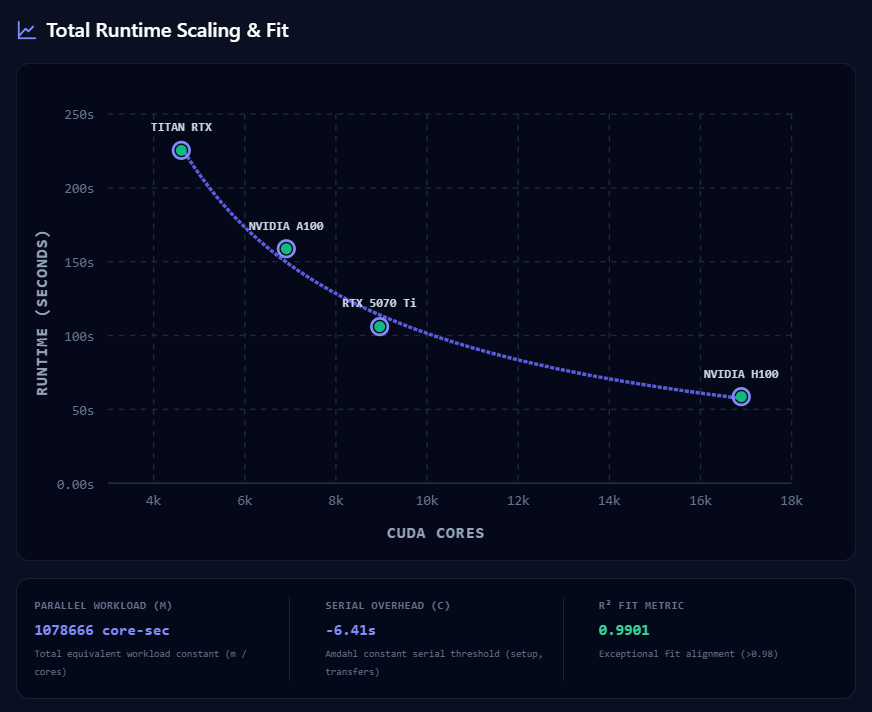
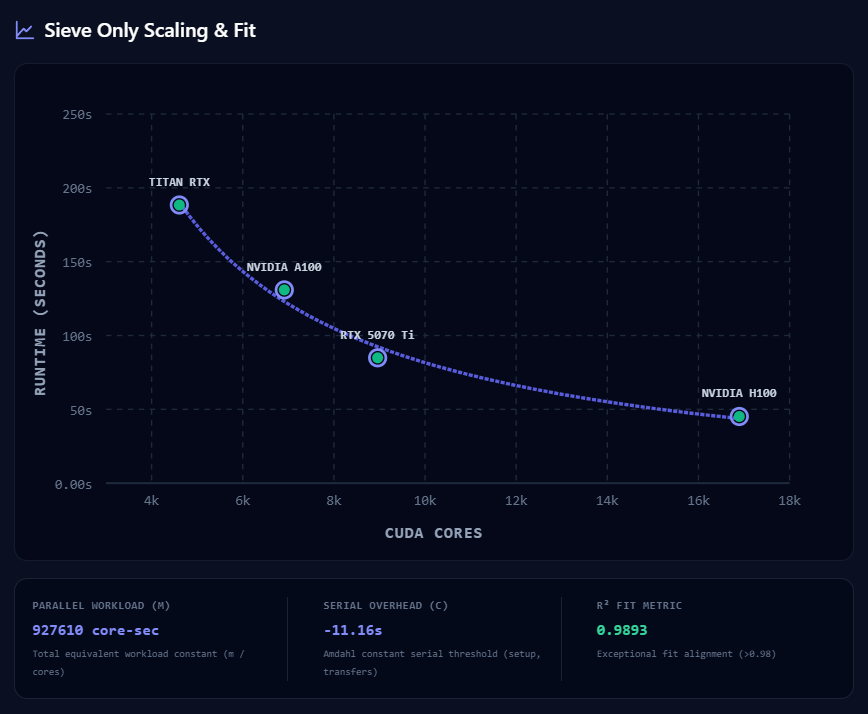
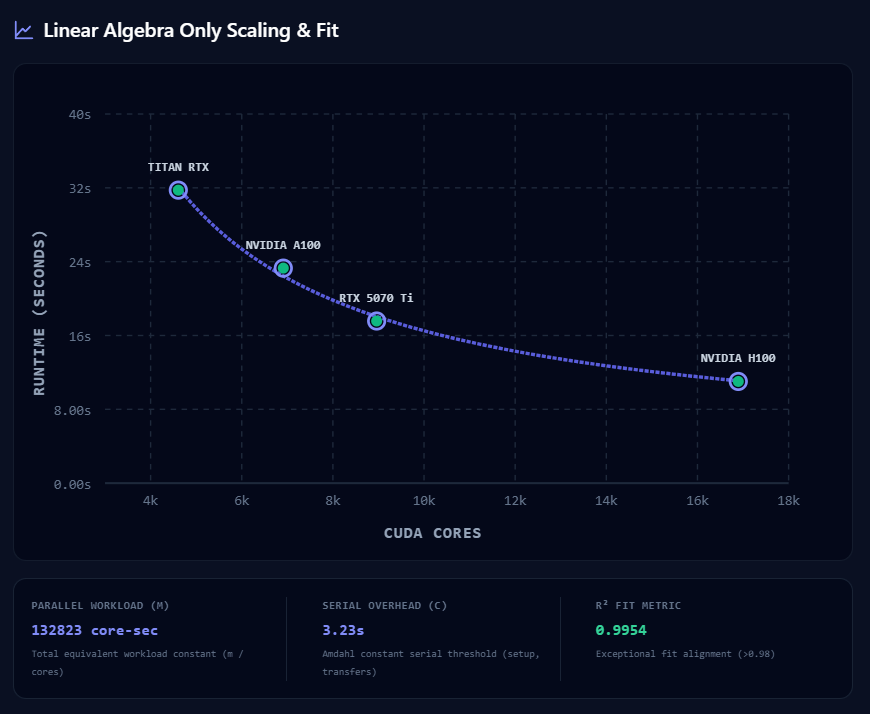
Runtime for RSA-100 class moduli scales on ‘large’ GPUs anti-proportionally with CUDA core count. This also applies to the sieve and linear algebra stages individually and is visualized in the graphs on the right hand side which is based on v1.0.0 timings. Since then we saw speed improvements in v1.0.4 and v1.0.6 across the board, preserving the observed excellent scaling, the only exception being the A100 concurrent half-sieves advantage in v1.0.6. Close investigation shows that the modern Blackwell architecture has a measurable performance advantage.
Comparing the runtimes of RSA-100 and RSA-155 on H100-SXM GPUs we observe that the cumulative runtime for RSA-155 falls within 50% of the naive asymptotic prediction for Quadratic Sieve runtime scaling over 5.5 orders of magnitude (i.e. extrapolating runtime from RSA-100 upwards using the leading term), despite transitioning from single GPU to data center scale distributed computing using a total of 1,081,344 CUDA cores.
Under the hood
The sieve is a three-kernel pipeline
polynomial generation → meta-sieve → sieve-and-scan
running over a hypercube of factor-base primes with Gray-code `b`-traversal. It supports a double-buffered, zero-synchronization batch mode that overlaps sieving with post-processing, plus CUDA-graph capture for low-launch-overhead replay. A single large-prime variant pairs partial relations through a GPU slab hash table with a fully asynchronous hot loop (no `cudaStreamSynchronize`).
Optional experimental matrix preprocessing follows a CADO-NFS-style expanded-matrix merge/filter design with a fully GPU-resident packed backend.
Block Wiedemann runs in three sub-stages
Krylov sequence → Berlekamp–Massey/`lingen` → reconstruction
over an SpMM engine that auto-selects among 10 distinct GF(2) sparse-matrix-vector formats and matching specialized CUDA kernels per matrix row block.
- All-GPU pipeline. Every stage — sieve, post-processing, large-prime matching, matrix build, linear algebra, and square root — runs on the GPU. The same code scales from a 25-watt Jetson Orin Nano to a multi-node GPU cluster.
- 512-bit arithmetic on the GPU. A custom `uint512` type implements full add/sub/mul/div/mod with Montgomery (CIOS) modular multiplication. Every operation is annotated `__host__ __device__`, so the identical code path validates on the CPU.
- No merge tree. The GPU matrix backend packs each entry into a single `uint32_t` as `(column_index << 8) | exponent` and carries `sqrt_Q` products straight through merges via Montgomery multiplication — eliminating the classical merge tree.
- 10 ways to multiply a sparse matrix. The Block Wiedemann engine measures each matrix and auto-selects from 10 GF(2) SpMM formats, from dense bitslice to Golomb-coded streams.
- Distributed sieve, one code path. Solo, cluster-coordinator, and cluster-worker all run the same sieve loop; the distributed mode is injected through a `nullptr`-by-default data-tap, so solo runs pay zero cluster overhead. Workers stream relations to the coordinator over a length-prefixed, CRC32-checked TCP wire protocol.
- Self-tuning. A four-stage autotuner with a convex sieve parameter optimizer and a persistent history database lets repeated runs at a given size start from previously discovered optima.
References
- F. Januszewski and C. Heinrichs, “CUDA-MPQS: A fully GPU resident quadratic sieve”, Computer software, version v1.0.6, Zenodo, 2026, open source (LGPL-3.0-only with NVIDIA CUDA Toolkit exception); source at https://github.com/drjanosch42/cuda-mpqs. Available: https: //doi.org/10.5281/zenodo.21619473
- F. Januszewski, “A GPU-resident block Wiedemann GF(2) linear algebra implementation”, Computer software, version v1.0.1, Zenodo, 2026, open source (LGPL-3.0-only); source at https://github.com/drjanosch42/block-wiedemann. Available: https://doi.org/10. 5281/zenodo.21606763