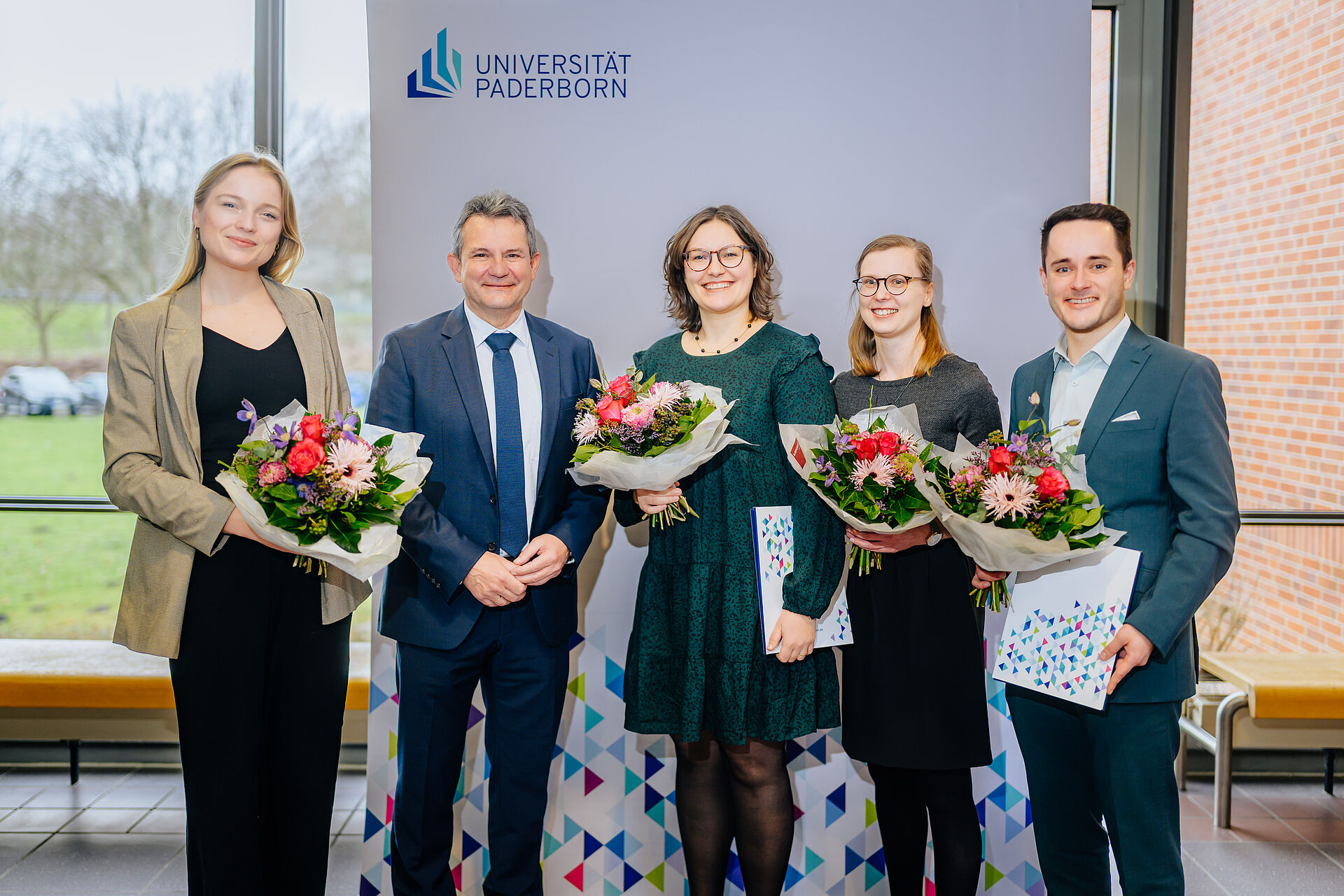
Paderborn University's traditional New Year's Reception took place on Sunday, 18 January 2026. At the event in the Audimax with around 400 guests, the university once again honoured outstanding achievements by academics and students.
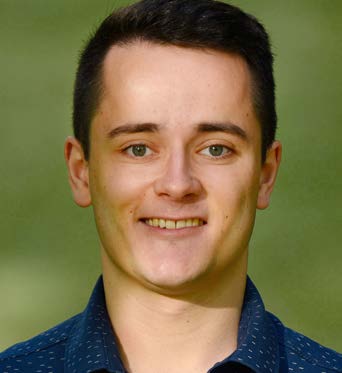
Mats Vernholz was one of the doctoral candidates honoured this year. He was honoured for his excellent doctoral dissertation and received the award at the New Year's reception. With this award, the university recognised his above-average commitment and outstanding academic achievements.
Following the award ceremony, we spoke to Mats Vernholz about his time as a student and researcher in the Department of Technology Education at the Institute of Electrical Engineering and Information Technology, his motivation and his plans for the future. In the interview, he talks about what particularly inspires him about his subject, the challenges he overcame during his studies and the role that support from teaching staff and fellow students played in his success.
We would like to congratulate Mats Vernholz on this special honour and wish him every success and all the best for the future.
Dr Vernholz, congratulations on the award! What does this award mean to you personally?
Very much. The award recognises that academic self-concepts are not just a niche topic in industrial-technical teacher training, but are central to professional development. For me personally, of course, it's a great reward after the often exhausting doctoral period! I'm also particularly pleased that the didactics of technology as a specialised didactics is being brought more into focus.
What is your doctoral dissertation about and why is the topic of academic self-concepts so relevant for teacher training?
I am investigating the structures of academic self-concepts in the context of teaching degrees and how they develop. Academic self-concepts describe how people perceive their own abilities and competences in certain areas (e.g. statements such as "I like maths"). Methodologically, I combine a quantitative study (questionnaires), based on the TPACK model, with an in-depth interview study based on the PCK model. Academic self-concepts are very relevant for (prospective) teachers. Research shows that they influence aspects such as the course of study, job satisfaction, resilience and professional development - i.e. central areas for teacher training.
What motivated you to work with prospective industrial-technical teachers in particular?
One of the main reasons is certainly that I myself come from an industrial-technical teaching background. At the same time, a look at the research landscape shows that this group is underrepresented in self-concept research, but at the same time is particularly heterogeneous - partly due to different routes into the teaching profession. This heterogeneity makes them exciting in terms of research and significant in terms of educational policy.
What role do practical experience and comparative processes play in students' self-image, as you have analysed in your work?
Practical experience plays an enormously important role for the academic self-concepts of industrial-technical teacher training students. This applies to both practical experience in the engineering sector and practical experience in the school sector. For example, one statement made in the interviews was: "[I] am not really familiar with any topics that I don't know, simply because I first did this Bachelor's degree, then also worked, and before that I did the practical training, which also helped me a lot, and so I don't really see any deficits there.".
What specific lessons can universities and teaching staff take away from your results for the design of teacher training programmes?
There are two key findings: On the one hand, it is important to interlink theory and practice in such a way that relevance is not only claimed but experienced. On the other hand, learning environments must be designed in such a way that comparisons do not become a "competition in the seminar room", but rather a constructive assessment of the current situation. Generative AI could also play a greater role here in the future in order to promote positive comparison processes.
You combine quantitative and qualitative methods in your doctoral dissertation. What What was particularly important to you about this mixed methods approach?
The mixed methods approach of my doctoral dissertation is clearly rooted in the research questions. On the one hand, I was interested in the structure of academic self-concepts. The quantitative study was useful here in order to investigate structures and differences in them depending on socio-demographic heterogeneity. At the same time, however, I was also interested in why the academic self-concepts were structured in this way. In this respect, the qualitative study provided deeper insights that would probably not have been possible with a purely quantitative approach.
What would you like to continue researching in the future and what are the next steps for you academically?
Over the next few months, I would like to further sharpen my research profile. One important step in this regard is certainly a two-month research visit to Curtin University in Perth (Australia), which I will be undertaking this year. Here, I will use the expertise I gained during my doctoral dissertation on self-perceptions of prospective teachers to examine the extent to which these can be promoted through personalised, AI-supported feedback.
What would you like readers, especially students, to take away from your excellent work?
That self-concepts are not a purely theoretical construct, but can guide their actions and be important for their academic and professional development: Consciously dealing with comparative situations, reflecting on practice in a targeted way and developing strengths in all professional dimensions. In concrete terms, this means seeking contact with fellow students and benefiting from their strengths while at the same time helping others with their own strengths.
What role has Paderborn University played in your academic career and why do you think it offers particularly good conditions for research and teacher training in technology didactics?
Paderborn University and the Department of Didactics of Technology have provided me with particularly good conditions for carrying out my research. The support I received from the Department of Didactics of Technology deserves special mention here. The consistently positive working atmosphere and the mutual, constructive support within the team have always been a positive accompaniment to my doctorate. At the same time, I would also like to mention the many offers of support that exist at the university, such as the Research Centre for Empirical Educational Research at the PLAZ Professional School of Education, where I was able to present my ideas and the results of my doctoral dissertation for discussion.